Pung Su: Environmental Harmony, Tactical Awareness, and the Way of Tang Soo Do
by MASTERSEGARRA
Long before modern conversations about energy, flow, and environment, Korean scholars and martial artists understood a simple truth:
Where you train shapes how you live.
In Korea, this wisdom is known as Pung Su (풍수, 風水)—often compared to Feng Shui, but more accurately understood as the Korean art of harmonizing human life with natural forces. In Tang Soo Do, Pung Su is not superstition or decoration. It is strategy, health, and longevity.
At its deepest level, Pung Su teaches both how to create harmony—and how to recognize advantage.
What Is Pung Su?
Pung Su literally means Wind (風) and Water (水)—the two forces that shape land, climate, and life. Traditional Korean scholars believed that the quality of wind and water determined the vitality of a location. Too harsh, and life struggles. Too stagnant, and life decays. When balanced correctly, a location produces Saeng Gi (생기)—living, nourishing energy.
For martial artists, this understanding extends beyond homes and landscapes. It applies directly to dojang placement, orientation, and internal training environments. A properly aligned space does more than feel calm—it actively supports focus, discipline, emotional balance, and long-term health.
Pung Su, the I Ching, and the Order of Change.
Pung Su is deeply connected to the I Ching (Book of Changes), which teaches that reality is governed by constant transformation. Through Yin and Yang and the Eight Trigrams, the I Ching describes how natural forces interact, shift, and rebalance.
Applied to space, these ideas influence:
- Direction and orientation
- Placement of entrances and exits
- Circulation of movement
- Balance between openness and enclosure
A space aligned with these principles supports clarity of mind, efficient movement, and emotional steadiness—qualities essential to Tang Soo Do practice.
The Magic Square and Spatial Balance
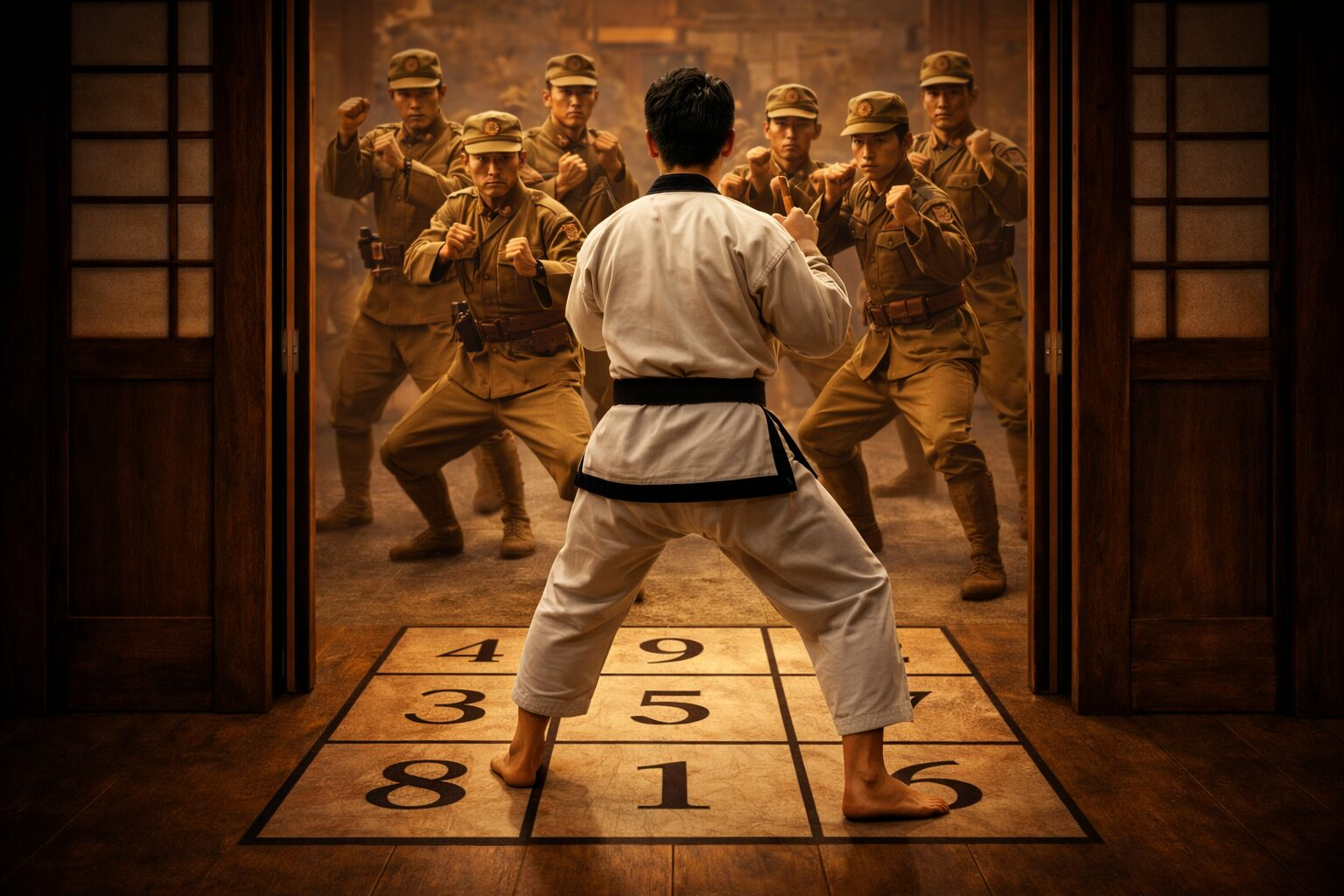
Another foundational concept influencing Pung Su is the Lo Shu Magic Square, a 3×3 grid where each row, column, and diagonal equals the same number. This ancient symbol represents proportional harmony.
In physical environments, it teaches:
- The center must remain open and accessible
- No area should dominate or collapse inward
- Energy should circulate evenly rather than bottleneck
A balanced space produces balanced behavior. When the environment feels ordered, the mind follows.
A Lesson from Kwan Jang Nim H.C. Hwang
Years ago, I had the opportunity to discuss Pung Su directly with H.C. Hwang, Kwan Jang Nim and son of Grandmaster Hwang Kee.
During our conversation, he shared something both simple and profound.
He explained that he always tried to have his dojangs face the sunrise.
The rising sun symbolizes renewal, growth, and forward motion. Morning light naturally energizes a space and sets a tone of beginning rather than decline. He also noted something beautifully practical: during winter months, this orientation helped melt snow and ice, keeping entrances clear and training consistent.
This was Pung Su in its purest form—not mystical ornamentation, but wisdom applied to daily life.
Environment as Strategy: A Lesson from Hwang Kee

Hwang Kee understood Pung Su not only as harmony—but as tactical awareness.
During his time in Manchuria, Hwang Kee was once confronted by a group of Japanese soldiers inside a restaurant. He was outnumbered, with little space to maneuver and no clear escape.
Rather than meeting force with force, he assessed the environment.
He identified a narrow doorway and deliberately positioned himself within it. By doing so, he forced the attackers to funnel through one at a time, eliminating their numerical advantage. The environment itself became his ally—disrupting coordination, preventing multiple attackers from engaging simultaneously, and turning chaos into control.
One by one, he defeated them—and escaped.
This was not brute strength.
It was environmental intelligence.
Harmony and Strategy Are Two Sides of the Same Coin
Pung Su teaches how to place things for balance and flow—but that same understanding reveals where traps, bottlenecks, and points of control exist.
When you understand:
- How energy enters a space
- Where movement naturally funnels
- Which areas create congestion or exposure
You gain not only harmony, but strategic awareness.
A space designed for calm can also be read for conflict.
A space that flows well can also be controlled when necessary.
Hwang Kee’s use of the doorway was Pung Su under pressure—applied instinctively because he understood space, movement, and human behavior.
Applying Pung Su in the Modern Dojang
For today’s studio owners, Pung Su is not about symbols on the wall—it is about function, flow, and first impressions.
- Good signage reduces confusion before students even enter, communicating order and professionalism.
- An accessible, welcoming entryway invites calm rather than intimidation.
- Well-placed bathrooms preserve dignity and prevent awkward disruptions.
- Clear foot-traffic flow allows students to move naturally from entrance to changing areas to the training floor without crossing active drills.
A well-designed dojang:
- Feels calm without being sterile
- Feels disciplined without being oppressive
- Feels welcoming without losing authority
Just as poor posture weakens technique, poor environmental alignment weakens training culture over time.
Why Pung Su Matters Today
In a modern world filled with noise, distraction, and stress, environment matters more than ever. Pung Su reminds us that:
- Training spaces shape mindset
- Architecture influences discipline
- Light, direction, and flow affect health
- Harmony produces resilience
For martial artists, this is not optional knowledge—it is responsibility.
Final Reflection
Pung Su teaches us that strength does not exist in isolation. It is supported—or undermined—by environment. Just as Tang Soo Do refines the body and mind, Pung Su refines the space in which that refinement occurs.
When internal discipline and external harmony align, training becomes deeper, calmer, and more sustainable.
That is not superstition.
That is tradition tested by time.
For deeper study into Tang Soo Do philosophy, environmental harmony, and Warrior-Scholar wisdom, continue your journey at:
http://tangsoodoresource.com/


