Is Tang Soo Do Dying?
by MASTERSEGARRA
It’s a hard question—and an uncomfortable one—but it’s a question worth asking honestly.
Tang Soo Do is not dying because of a lack of techniques, forms, or history. It’s at risk when participation becomes passive. When practitioners train quietly, consume knowledge silently, and fail to support the ecosystem that keeps the art alive, the roots begin to dry.
In Korean, the word for duty is 의무 (Ui-Mu). Ui-Mu is not optional. It is a moral responsibility tied to membership in something greater than yourself. In Tang Soo Do, your Ui-Mu does not end at the edge of the dojo/dojang mat.
Your Duty to Your School
If you train somewhere, you should support it—consistently and visibly. That means showing up, paying attention, speaking positively, and encouraging others to train. Schools do not survive on tradition alone. They survive because students believe in them and stand behind them.
If your school closes, a lineage weakens. When enough schools disappear, an art fades.
Your Duty to Organizations
Even if you are not part of a formal organization—or even if you disagree with aspects of one—your Ui-Mu is to support the idea of structure, continuity, and documentation. Organizations preserve records, publish material, host events, and create bridges between generations.
You don’t have to agree with everything to understand that fragmentation weakens an art. Silence helps no one.
Your Duty to Knowledge Sharing
Books, articles, podcasts, and online videos are the modern scrolls. When practitioners refuse to write, record, or share out of fear of criticism or “giving away secrets,” knowledge goes to the grave.
Tang Soo Do has already lost too much. If you know something—document it. If you learned something—credit it. If you benefited from someone’s work—support it.
Your Duty on Social Media
Social media is not the enemy. Neglect is.
If Tang Soo Do is invisible online, it might as well not exist to the next generation. You should like, comment, share, and participate in respectful discussion groups. Algorithms reward activity, not purity. If you don’t water the digital roots, the tree does not grow.
You don’t need to be loud. You need to be present.
Why the World Still Needs Tang Soo Do
The truth is, the world needs Tang Soo Do now more than ever.
It needs tradition—not as nostalgia, but as an anchor. It needs a philosophy that strengthens character, not just bodies. Tang Soo Do was never meant to be only about winning fights; it was meant to develop disciplined individuals who contribute positively to their families, schools, and communities.
Today, arts like MMA and Brazilian Jiu-Jitsu dominate attention spans, especially among younger generations. They are effective systems—but effectiveness alone is not enough. Technique without philosophy produces skill without direction. Power without a moral compass leads nowhere good.
Young people today are not lacking toughness—they are lacking guidance. They need a framework that teaches patience, respect, self-control, perseverance, and responsibility. They need a philosophical compass that helps them navigate pressure, identity, conflict, and uncertainty in a complex modern world.
Tang Soo Do offers that compass.
It teaches restraint alongside strength. Reflection alongside repetition. Character alongside capability. If we allow Tang Soo Do to fade into obscurity, we don’t just lose an art—we lose a tool the world desperately needs.
Water the Tree
Tang Soo Do is a living organism. It requires care, attention, and contribution. You inherited this art because someone before you chose to teach instead of hoard, to share instead of hide.
Now it’s your turn.
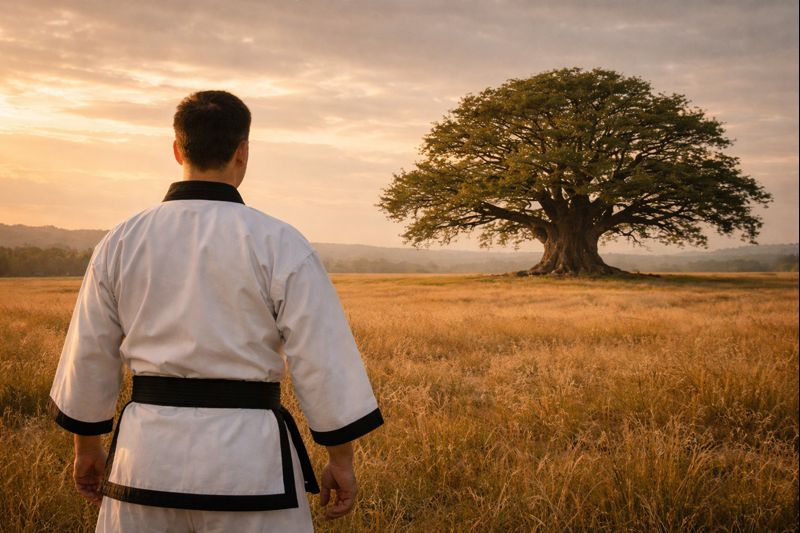
If we stop watering the tree of Tang Soo Do—through support, participation, and Ui-Mu—it will not die overnight. It will wither quietly. And by the time we notice, it may be too late.
Be a caretaker, not a spectator.
Visit tangsoodoresource.com for deeper study, preservation efforts, and resources dedicated to keeping the Warrior-Scholar path alive for future generations.


