The Power Behind Every Punch: F = M × A
by Daniel Segarra
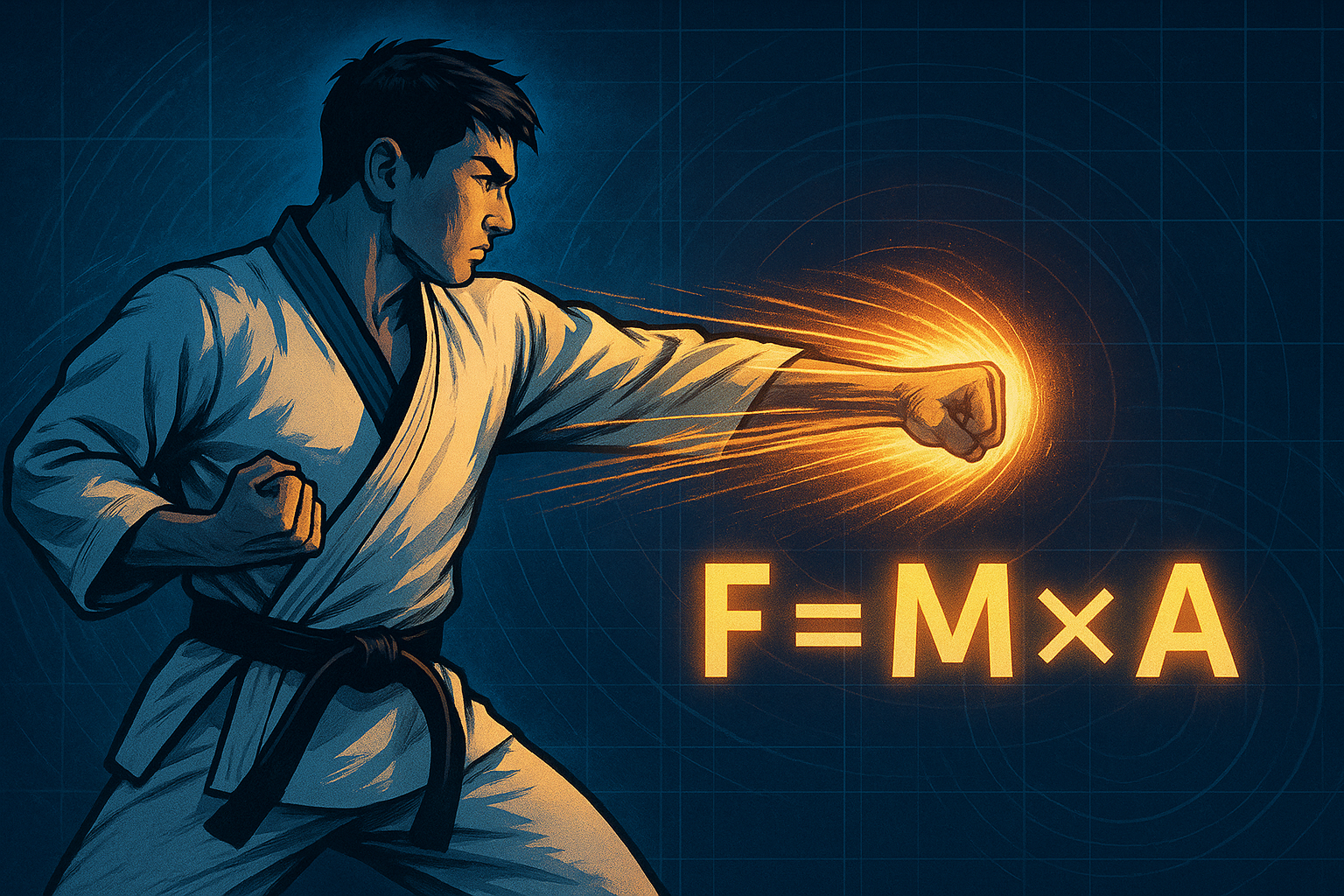
When people watch martial artists smash boards or deliver lightning-fast combinations, it can look like magic. But behind every powerful strike is a bit of beautiful science — specifically Newton’s Second Law of Motion, represented by the formula:
F = M × A
Force = Mass × Acceleration
Understanding this simple equation helps us explain why some punches land like a truck while others barely make an impression — regardless of how big or strong the person looks.
🥋 What Does F = M × A Mean?
Let’s break it down in everyday language.
✅ Mass (M)
Mass refers to how much matter something has.
In martial arts, this represents your body weight — or more specifically, how much of your body you put behind your punch.
A punch that uses only your arm = low mass
A punch that engages your legs, hips, and core = high mass
More mass behind the strike → more potential force.
✅ Acceleration (A)
Acceleration is how fast something speeds up.
The faster you launch your fist and body toward your target, the more force you deliver. This is why relaxed, explosive motion is more powerful than stiff, slow movement.
Speed matters — a lot.
✅ Force (F)
Force is the result — the actual impact or “hit strength” produced.
So, if you want to strike harder, you can:
- Increase the mass behind your punch (use whole-body mechanics)
- Increase acceleration (snap the punch faster)
The best techniques combine BOTH.
🥋 Why Small People Can Hit Hard
Ever see a kid break a board?
It’s not because they’re big — it’s because they use good technique.
A smaller martial artist who rotates their hips and accelerates quickly can generate remarkable force. Meanwhile, a large adult who moves slowly — without body coordination — may not hit very hard.
So power is not just about size…
It’s about mechanics + speed.
⚙️ Technique Matters
Big muscles don’t guarantee big power.
The strongest punchers aren’t always the most muscular — they’ve simply mastered how to coordinate their whole body so that:
- Feet press into the ground
- Legs drive and rotate
- Hips power the motion
- Torso and shoulders follow
- Fist fires forward in a snapping motion
This chain reaction channels mass and speed into one explosive instant.
That tiny moment of contact is where the physics comes alive.
🔹 Grandmaster Hwang Kee & Newton’s Laws
Grandmaster Hwang Kee — founder of the Moo Duk Kwan — emphasized that true striking power requires whole-body motion, not just arm strength. He taught that the feet, legs, hips (huri), torso, and arms must work together.
This principle aligns directly with Newton’s Second Law — the idea that force comes from mass multiplied by acceleration.
Even more fascinating is that Hwang Kee didn’t just imply this…
he explicitly referenced Newton’s Laws in his writings.
👉 In the English-language edition of Tang Soo Do (Soo Bahk Do), on page 95, Hwang Kee discusses Newton’s Laws to explain how proper body mechanics create power.
He highlights:
- Sequential movement
- Hip rotation
- Acceleration at the moment of impact
These are all practical ways to increase M × A, and therefore F.
So when Hwang Kee instructed students to turn their hips and align their entire body during a strike, he was not only teaching traditional technique — he was reinforcing universal physics.
Tang Soo Do is one of the few martial arts whose founder intentionally connected ancient practice with modern scientific principles.
🔹 A Clear Physics Example: Throwing vs. Shooting a Bullet
To understand why acceleration is so important, consider this example:
✅ Throwing a bullet
If you throw a bullet by hand:
- Mass = the same small metal object
- Speed = relatively low
- Resulting force = small
Someone might feel it… but it will not penetrate.
✅ Shooting a bullet
If you fire the same bullet from a gun:
- Mass = unchanged
- Speed = extremely high
- Resulting force = massively greater
The only major difference is acceleration and velocity.
Because kinetic energy is calculated as:
KE = ½ m v²
…the velocity is squared.
That means even doubling the speed creates four times the energy.
So shooting a bullet instead of throwing it multiplies destructive power dramatically — not because the bullet is heavier, but because it is traveling much faster.
Same mass.
More acceleration.
Exponential increase in power.
That is Newton’s Law in action.
It’s the same in martial arts:
A fast, well-coordinated punch produces far more force than a slow arm-only punch.
🥋 Connecting It Back to Punching
Tang Soo Do teaches:
✅ Drive from the ground
✅ Rotate the hips
✅ Let the body support the punch
✅ Accelerate sharply on impact
These principles increase:
- The amount of mass behind the strike (whole body → fist)
- The acceleration at the moment of contact
That is F = M × A — in real life.
This is why a trained child can break a board.
With good mechanics, they multiply both mass and acceleration.
It’s physics, not magic.
And Grandmaster Hwang Kee knew it — which is why he referenced Newton’s Laws right in the textbook.
🔹 Real-Life Examples Beyond Martial Arts
- Swing a baseball bat faster → harder hit
- Kick a soccer ball with your whole body → more distance
- Throw a rock harder → farther impact
Across sports and everyday activities, mass + acceleration determines how powerful an action is.
🧠 Why Understanding This Helps Students
Knowing the science helps students:
✅ Punch smarter, not harder
✅ Improve technique
✅ Avoid injury
✅ Use their body more efficiently
✅ Understand why technique beats brute strength
It also helps beginners quickly see that:
You don’t have to be big to be powerful —
you just need good mechanics and acceleration.
✅ Final Thoughts…
Whether you’re breaking a board, throwing a punch, or simply watching a powerful kick fly through the air, the same truth holds:
Power is not just strength — it’s science.
Newton’s Second Law, F = M × A, teaches us that force comes from:
- Using more of your body (mass), and
- Moving it faster (acceleration)
Grandmaster Hwang Kee understood this deeply. By emphasizing whole-body technique and directly referencing Newton’s Laws in Tang Soo Do (Soo Bahk Do), he showed that martial arts is more than tradition — it is applied physics.
From the example of a thrown vs. fired bullet to the rotation of your hips in a simple punch, we see that speed + coordination = power. Size alone doesn’t determine force. Proper mechanics allow children and adults alike to create remarkable impact.
So the next time you practice a punch, turn your hips, drive with your legs, and snap with speed. You’re not just copying a motion —
you’re putting timeless science into action.
Martial arts is where ancient wisdom meets modern understanding, proving that:
Anyone can strike with power when technique and physics work together.
Train smart, move with purpose, and let science amplify your strength.


